Outflow (VLP)
What the well needs at the bottom to lift fluid to surface.
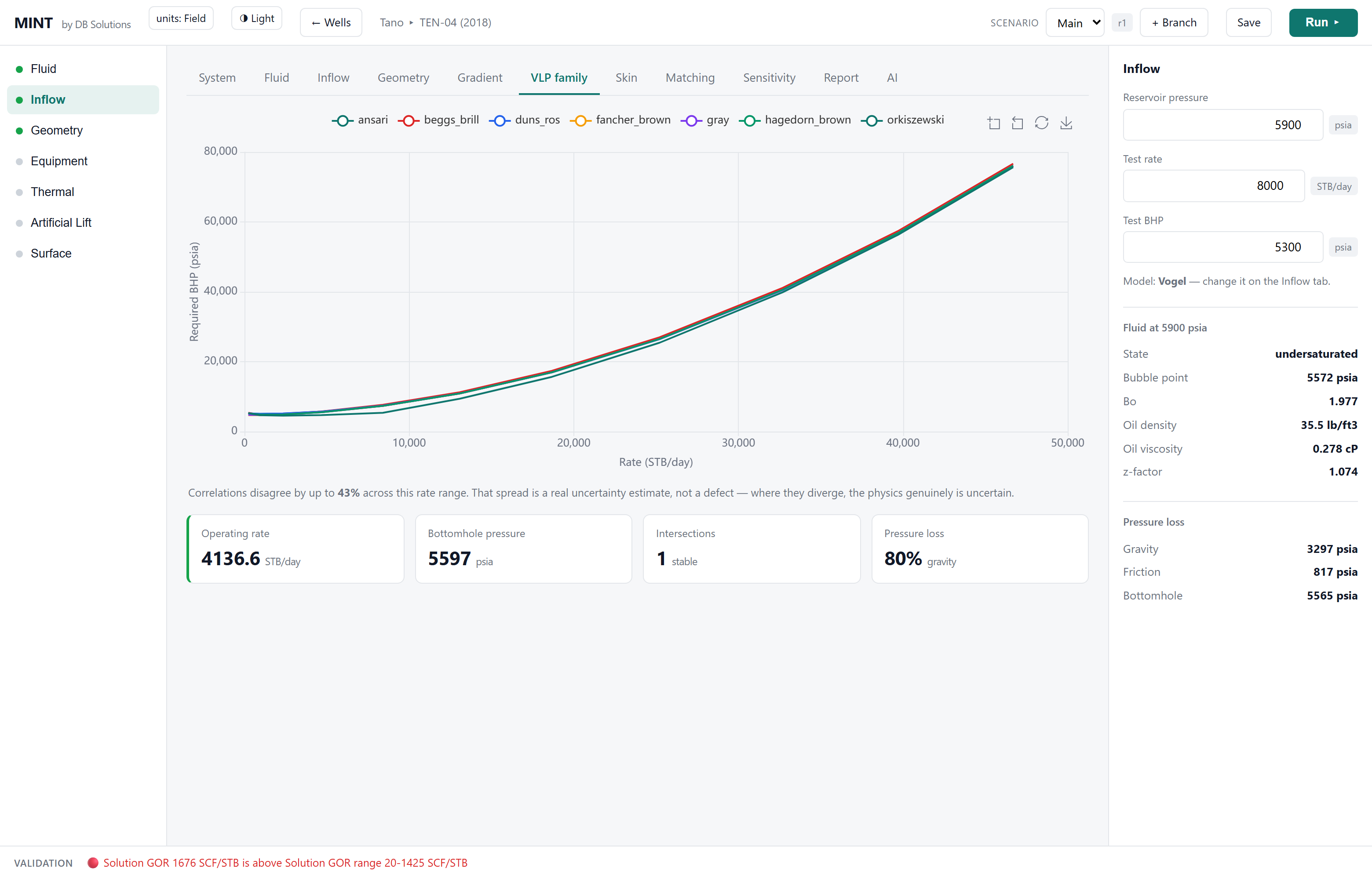
The correlation family view
MINT runs all the correlations and plots them together, rather than making you pick one blind and hope.
Where they agree, you can be confident. Where they disagree - and the screen tells you by how much - the physics genuinely is uncertain, and that spread is a real uncertainty estimate rather than a defect to hide.
| Correlation | Character |
|---|---|
| Fancher-Brown | no-slip; a QC floor, not a predictor - if a correlation is below it, something is wrong |
| Hagedorn-Brown | the workhorse for vertical oil wells |
| Beggs-Brill (+ Payne) | handles inclination properly; the default for deviated wells |
| Duns-Ros, Orkiszewski | flow-regime-based classics |
| Gray | gas condensate wells |
| Poettmann-Carpenter | older, kept for comparison with legacy studies |
| Guo-Ghalambor | four-phase; validated against the textbook - where we found a misprint in the printed equations |
| Ansari | mechanistic - solves the physics rather than fitting data |
The gradient
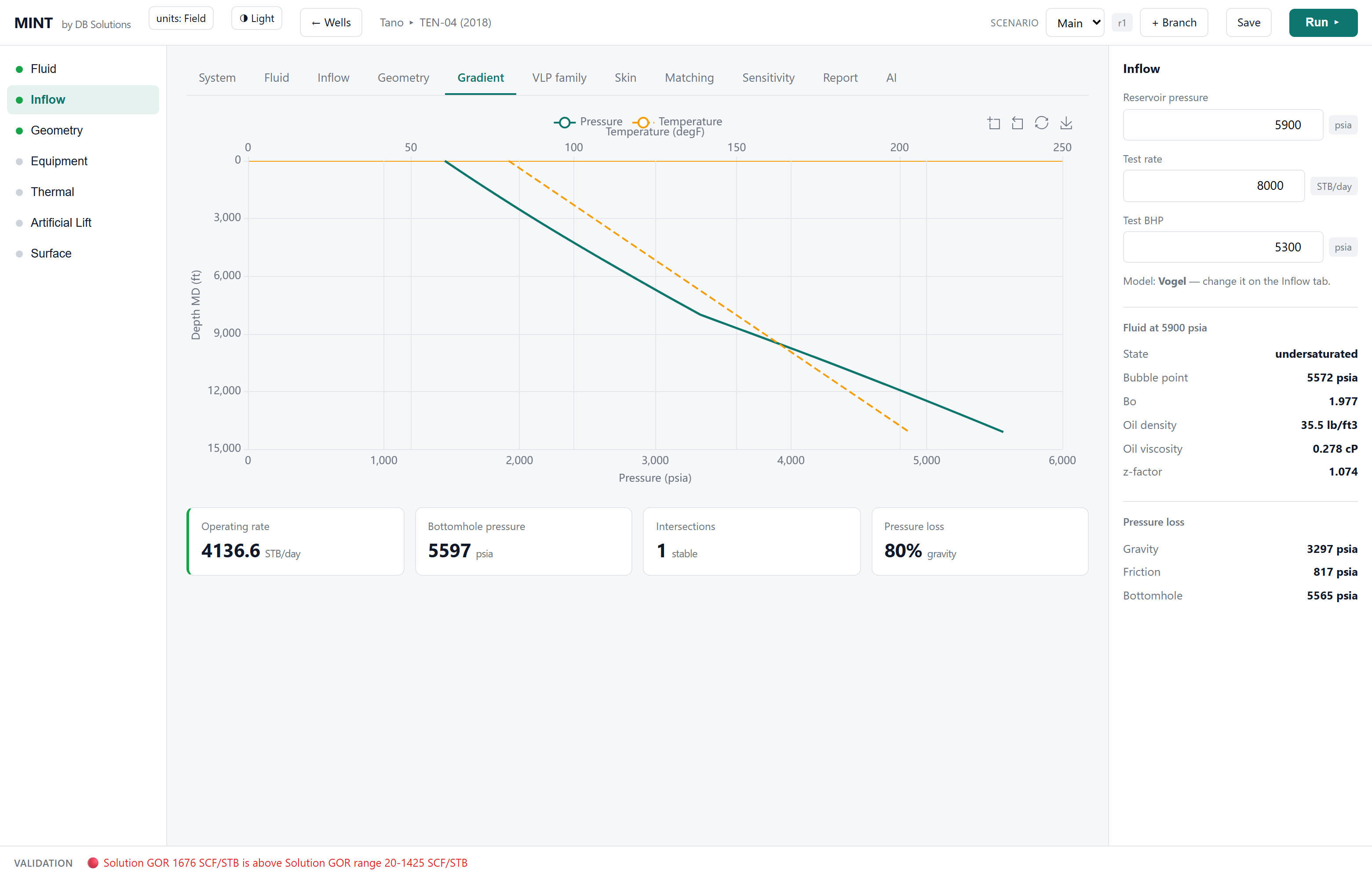
The traverse marches from the wellhead down, converging pressure and fluid properties at each step. Two things make it trustworthy:
- adaptive sub-stepping - a step that will not converge (a flow-pattern boundary, or a phase boundary in a compositional fluid) is retried in halves until the discontinuity falls inside one sub-step
- step-size independence - halving the step changes the answer by ~0.2%, which is how you know you are integrating rather than guessing
Geometry
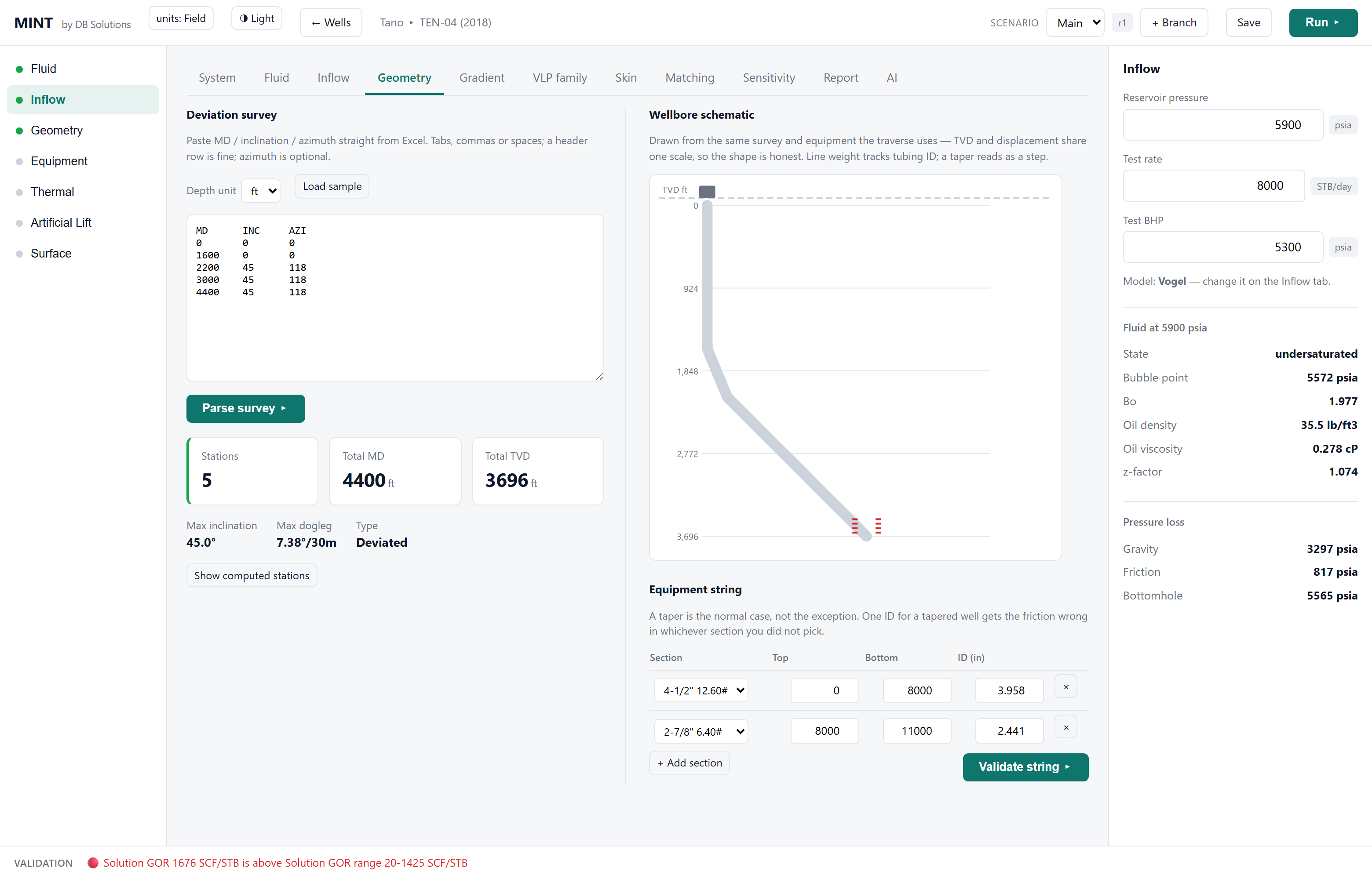
Paste a deviation survey straight from Excel - any number of stations, feet or metres, and MINT honours the unit you tell it. Minimum-curvature throughout.
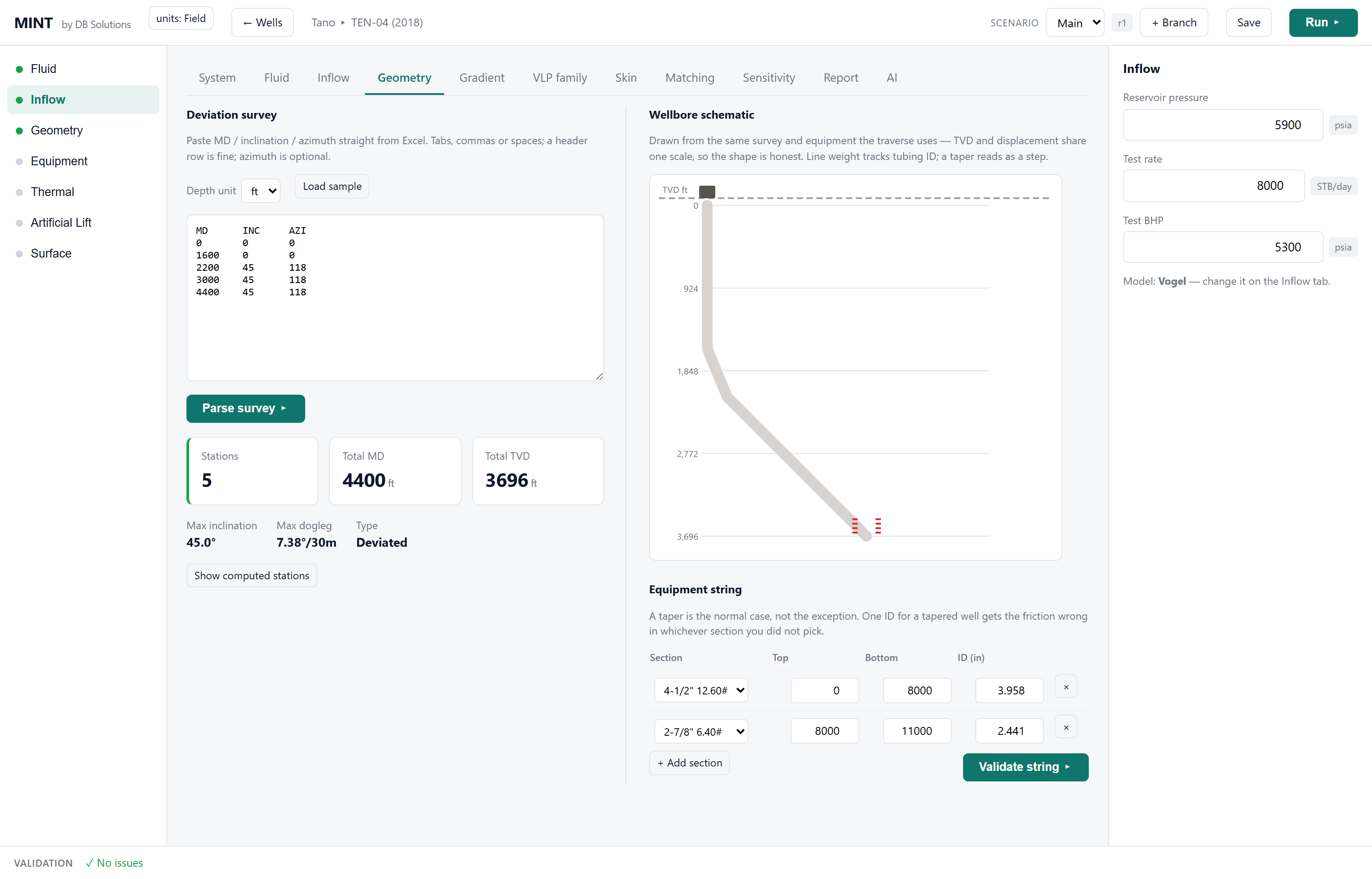
Tapered strings are real: a 4½ × 2⅞ string modelled as a single ID is wrong by several hundred psi, so each section carries its own diameter and roughness into the traverse.
Temperature
The wellhead runs hot when a well flows hard. MINT offers Rough Approximation (a linear profile) and Sagar-Doty-Schmidt (SPE 19702), which solves the actual heat balance against the geothermal gradient.