The nodal solve
Everything in MINT exists to serve one calculation: where does the inflow curve cross the outflow curve?
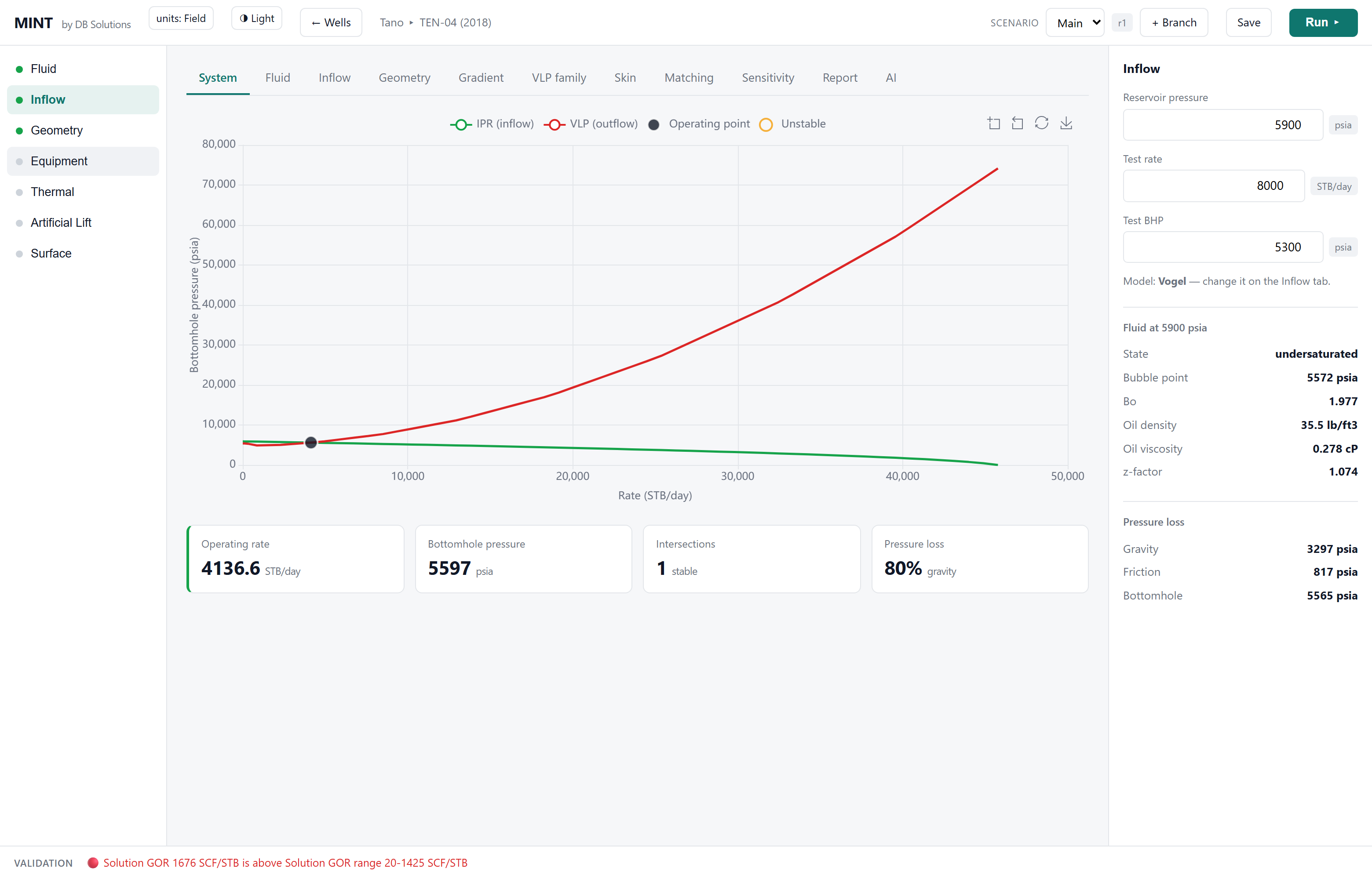
What the two curves are
| Curve | Colour | What it says |
|---|---|---|
| IPR - inflow | green | what the reservoir will deliver at a given bottomhole pressure |
| VLP - outflow | red | what the well needs at the bottom to lift that rate to surface |
Where they cross, supply equals demand. That is the well's natural operating point: the rate it will actually flow at, and the bottomhole pressure it will actually sit at.
How MINT solves it
Not by comparing two tables row by row. That is the single most common way to get this wrong - the curves are sampled on different axes, so matching them by index compares unrelated points and the "intersection" is an artefact.
Instead MINT:
- builds both curves on one shared rate axis
- brackets every sign change of
inflow(q) − outflow(q)on a coarse grid - refines each bracket with Brent's method
- classifies each root as stable or unstable from the slope of the difference through the crossing
A grid of 24 and a grid of 200 agree to 1e-12, because the grid only has to bracket - Brent does the accuracy. That is why the solve takes ~1.5 s and not ~100 s.
Multiple intersections and dead wells
A well can cross twice. The lower-rate crossing is usually unstable: a small dip in rate makes the well need more lift than the reservoir can supply, and it dies. MINT marks both and tells you which is which, rather than silently returning the first one it finds.
If the curves never cross, the well does not flow naturally. MINT says so explicitly instead of returning a meaningless number. That is the case artificial lift exists to fix.
Reading the numbers under the plot
| Card | Meaning |
|---|---|
| Operating rate | the stable crossing, in your display units |
| Bottomhole pressure | the pressure at that crossing |
| Intersections | how many crossings, and how many are stable |
| Pressure loss | the split between gravity (hydrostatic) and friction |
The gravity/friction split is the most actionable number on the screen. A well that is 80% gravity is a candidate for gas lift or a smaller tubing string. A well that is friction-dominated will not improve from either - it needs a bigger conduit.