Matching
This is why PROSPER is believed, and it is the spine of MINT.
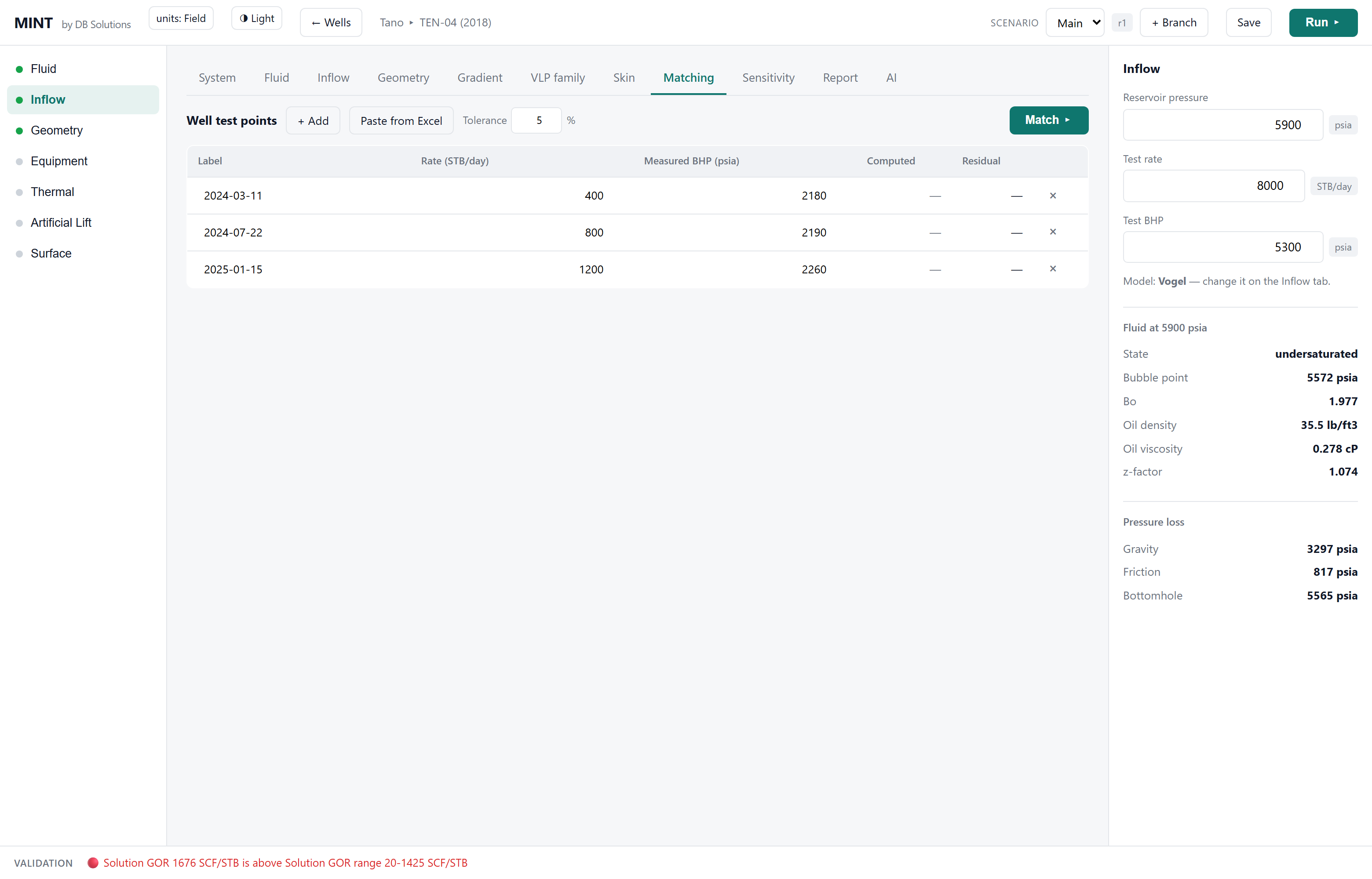
Nobody buys a well model because it has many correlations. They buy it because it reproduces their well's measured data before it predicts anything.
What can be matched
| Layer | Tuned by | Against |
|---|---|---|
| PVT | Rs / Bo / viscosity multipliers | lab report (CCE, CVD, DL) |
| VLP | α gravity and β friction multipliers | flowing gradient survey or gauge data |
| IPR | productivity index | multi-rate well test |
All three sit on one shared regression module, so they behave identically and a fix to one is a fix to all.
Reading the result
MINT reports residuals against your tolerance, not a hidden default, and separates:
- bias - the model is consistently high or low. Fixable by tuning.
- scatter - the model is inconsistent. Tuning will not fix it; usually the data or the flow regime is the problem.
A match that reduces bias to zero while leaving scatter untouched has not made the model better, and you should be able to see that.
The honest limit
Matching multipliers are fudge factors with physical names. A β of 1.05 is a reasonable friction correction. A β of 3.0 means the correlation is wrong for this well and you should change correlation, not tune harder.
MINT flags multipliers that have run far from unity for exactly this reason.