Fluid (PVT)
Fluid properties drive everything downstream. The pressure traverse asks for Bo, Rs, μo, ρo, z and μg at every depth step, so a PVT error does not stay in the PVT tab - it moves the operating point.
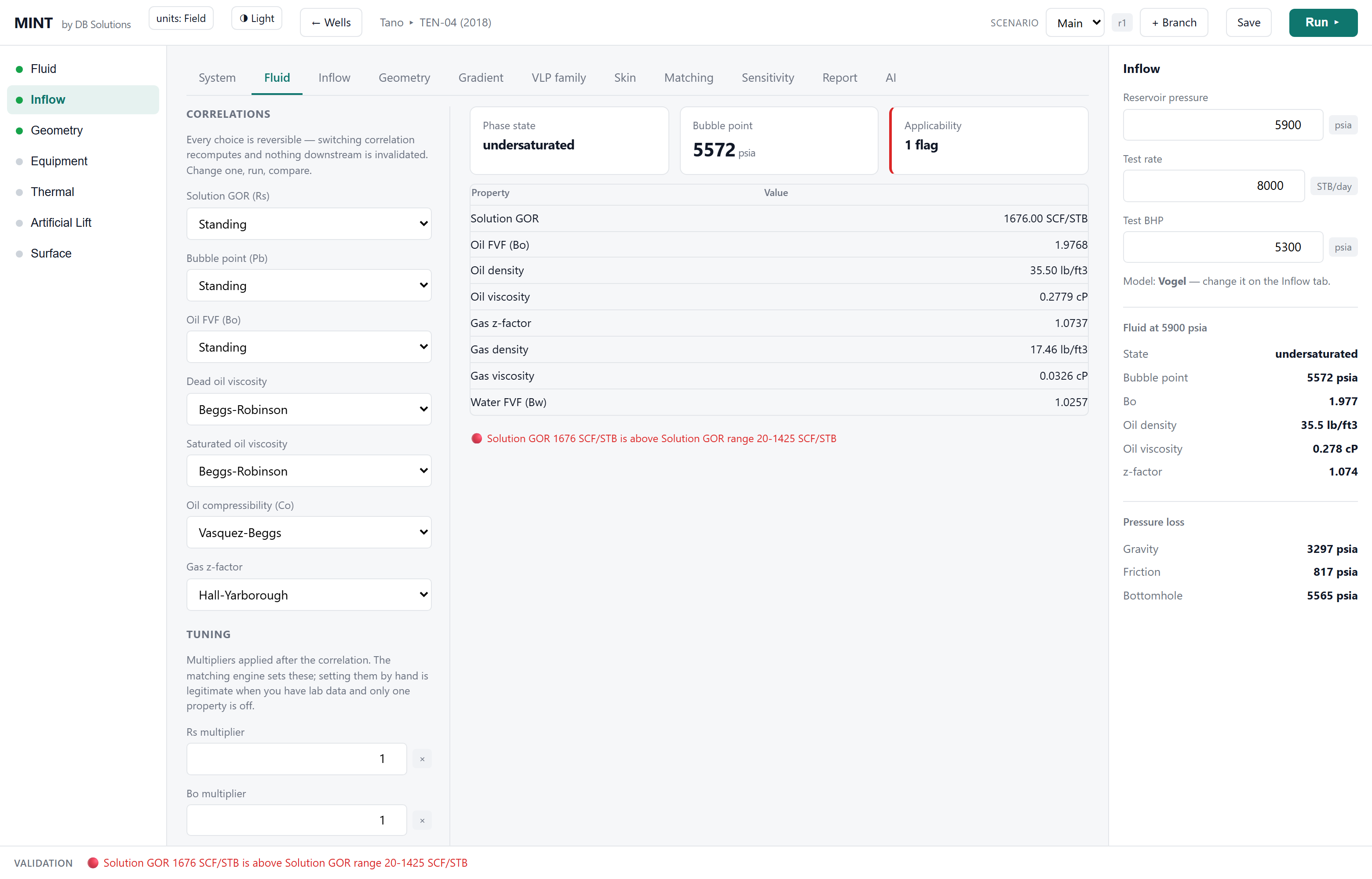
Three ways to define a fluid
1. Correlations (default)
Pick a correlation per property. MINT ships 25, each carrying its published applicability range.
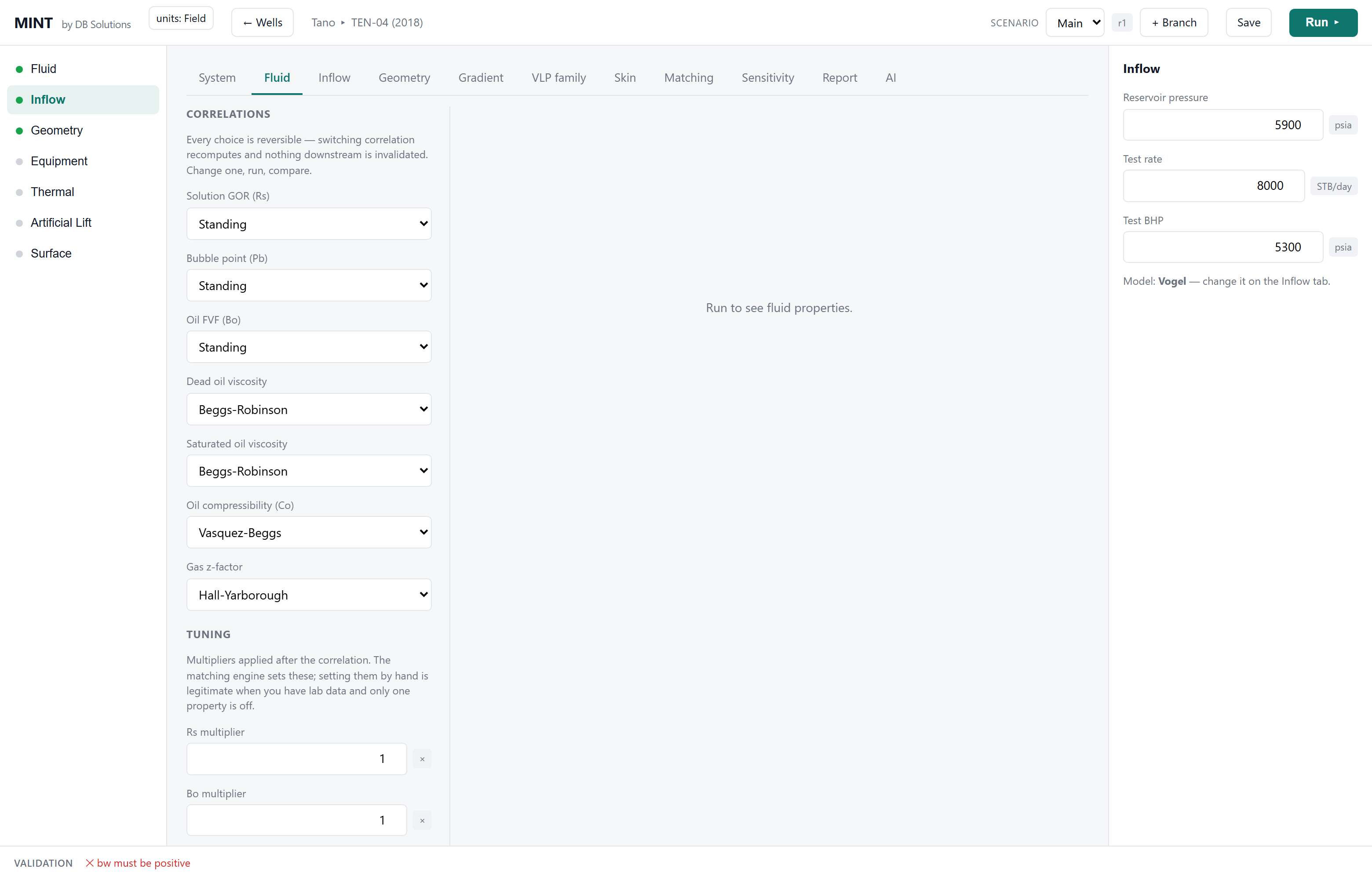
Use one outside its envelope and you get a flag naming the offending variable and its range - at the point of use, and again in the report. The flag is not a blocker. Extrapolation is sometimes the right call; being unaware of it never is.
2. Lab tables
Paste a lab report (CCE / CVD / differential liberation) and MINT interpolates your measured values instead of correlating. Cheapest possible route to a trusted model when you have the data.
3. Compositional (EOS)
Give a composition and MINT runs Peng-Robinson or SRK through the same
properties(p, t) contract the black-oil path uses. Retrograde condensate,
dew-point tracking and phase-boundary crossing all work end to end - the rest of
the engine cannot tell the difference.
Tuning
Multipliers on Rs, Bo and viscosity let you shift a correlation onto your lab data. When any multiplier is not 1.0, the report discloses it. A tuned fluid that does not say it is tuned is how a model quietly becomes fiction.
Matching to lab data
Give MINT your measured points and it will regress the multipliers and rank every correlation by standard deviation against your data - so you find out which one actually fits your fluid rather than which one is most famous.
That ranking is half of why PROSPER is believed. It is in MINT.